Double-Acting vs. Spring-Return Pneumatic Actuators: Key Differences and Selection Considerations
Double-Acting vs. Spring-Return Pneumatic Actuators: Key Differences and Selection Considerations
In industrial automation systems, pneumatic actuators play a critical role in valve control.
Among them, double-acting and spring-return (single-acting) pneumatic actuators are the two most commonly used designs.
There is no universal “better” option—proper selection depends on process requirements, safety expectations, and system design objectives. Understanding their operating principles and differences is essential for correct actuator selection.
1. Characteristics of Double-Acting Pneumatic Actuators
Double-acting actuators use compressed air to drive both opening and closing movements.
Air pressure is required throughout the entire valve operation cycle.
Key features:
-
Relatively simple structure
-
Stable output torque
-
Strong dependence on air supply
-
Valve remains in last position if air supply fails
Typical applications:
-
Systems with stable air supply
-
Applications without strict fail-safe requirements
-
Water treatment, HVAC, and general industrial pipelines
2. Characteristics of Spring-Return Pneumatic Actuators
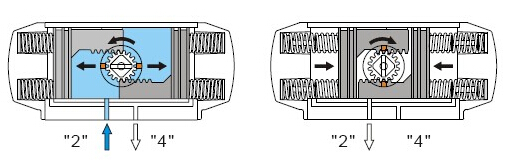
Spring-return actuators use air pressure in one direction and an internal spring for the return movement.
In case of air failure, the valve automatically returns to a predefined open or closed position.
Key features:
-
Fail-safe function in air loss situations
-
Higher safety level
-
More complex structure
-
Higher cost and larger size compared to double-acting designs
Typical applications:
-
Oil & gas and chemical industries
-
Critical pipelines requiring defined fail-safe positions
-
Projects with strict safety or owner specifications
3. Key Comparison in Engineering Selection
| Item | Double-Acting | Spring-Return |
|---|---|---|
| Drive method | Air open / Air close | Air + Spring return |
| Air failure status | Remains in position | Automatically returns |
| Safety level | Standard | Higher |
| Structural complexity | Lower | Higher |
| Cost | Lower | Higher |
4. Practical Selection Recommendations
During actuator selection, consider the following questions:
-
Is a defined safe position required during air failure?
-
Are there mandatory safety standards or project specifications?
-
Is system simplicity or cost optimization a priority?
Correct selection improves system reliability while balancing safety and investment.
Conclusion
Both double-acting and spring-return pneumatic actuators serve specific application needs.
The key is not choosing one over the other, but selecting the option that truly matches the operating conditions and safety requirements.
A clear understanding of actuator behavior during the design stage leads to more reliable and efficient systems.